
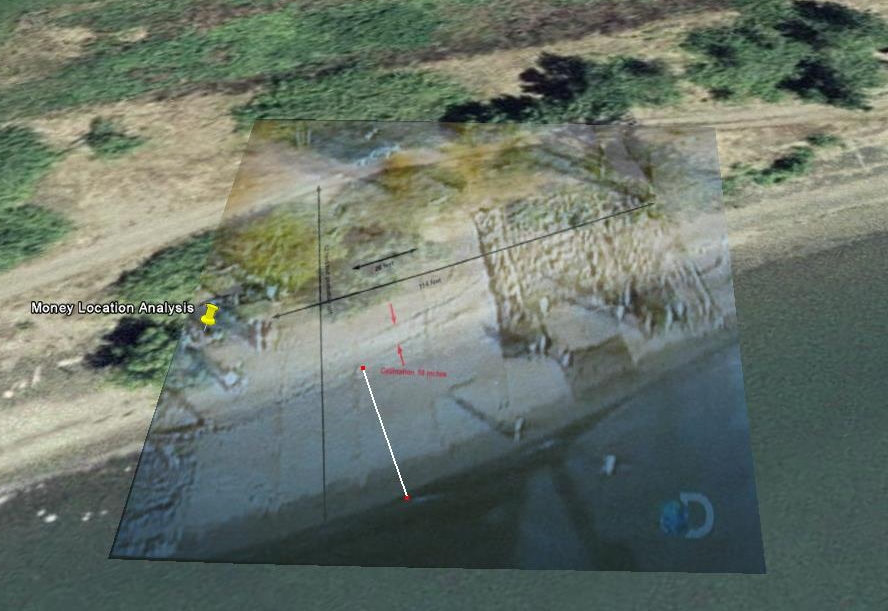
 In 1980, then nine year old Brian Ingram was with his family along the Columbia River on a beach called Tena bar (Fig. 1). While scooping out the sand for a fire pit, he uncovered three bundles of decomposed cash. The $5,800 dollars in twenty-dollar bills still had intact rubber bands and were identified by their serial numbers as part of Cooper’s original 200K in ransom money. The FBI brought in a team of agents to comb the beach looking for the rest of the cash, but only small fragments were found. During that time, an associate professor of geology at Portland State University, Dr. Leonard Palmer was brought in to determine the circumstances surrounding the burial of the money which resulted in the Palmer Report.
The exact position of the money find was not recorded in the FBI archive. In 1974 a dredging operation dumped tons of sand on Tena Bar. Dr. Palmer discovered a clay layer in the sand that figured heavily into his report. These factors all influence the interpretation of the money find. In order to better understand the money found on Tena Bar, these factors all needed to be reexamined.
 Tena Bar was visited by the Cooper Research Team in March of 2009. The beach was continuously photographed along its entire length for reference. A planned identification of surviving trees from 1980 could not be accomplished due to several feet of severe erosion along the entire length of beach. A single surviving tree had fallen over and was used in conjunction with the dirt road, to place photographs from 1980 into proper orientation.
The erosion of the beach was measured using the exposed roots of small trees at several locations. Samples of wood, metal and other artifacts embedded in the exposed layers were collected for later analysis. GPS positions of trees and roads were recorded.
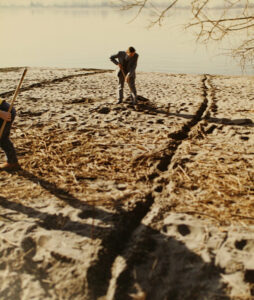
Multiple photos at different angles in the FBI Archive showed the hole dug where the money was found. Pictures showed that the FBI cut marker lines in the beach sand( Fig. 2). These lines were measured against known distances in the images and determined to be at 20 ft intervals. These lines allowed for macro scale distance measurements in the photos. The various trees and items in the picture backgrounds were correlated to zero in on the original location near the small trees on the beach. This smaller area was then correlated with photographs of longer views to place it in context with the major trees and dirt road running just behind the beach. The GPS position of the recovered money find was determined to be at: lat. 45.717888, long. -122.759500
A bundle of one dollar bills was tossed into the water on a fishing line to determine river flow and direction. How the bundle moved in reaction to wave action from passing boats was also noted.
A timeline of events on Tena Bar was reconstructed for context [3]